
Choosing the right device in today’s crowded market can feel overwhelming. From smartwatches and fitness trackers to smart rings, each promises better health insights, smarter notifications, and longer battery life. This guide delivers a clear wearable technology comparison focused on what truly matters: sensor accuracy, ecosystem integration, battery performance, and meaningful real-world features. Instead of repeating marketing claims, we evaluate how these devices perform in everyday use. By the end, you’ll have a practical framework to match your health, fitness, and productivity goals with the wearable that fits your lifestyle and budget with confidence.
The Three Tiers of Wearable Tech: Which Category is for You?
As we delve into the nuances of different wearable technologies, from their standout features to their accuracy and overall value, you’ll find insights on how to minimize common pitfalls in our guide to ‘Error Rcsdassk‘.
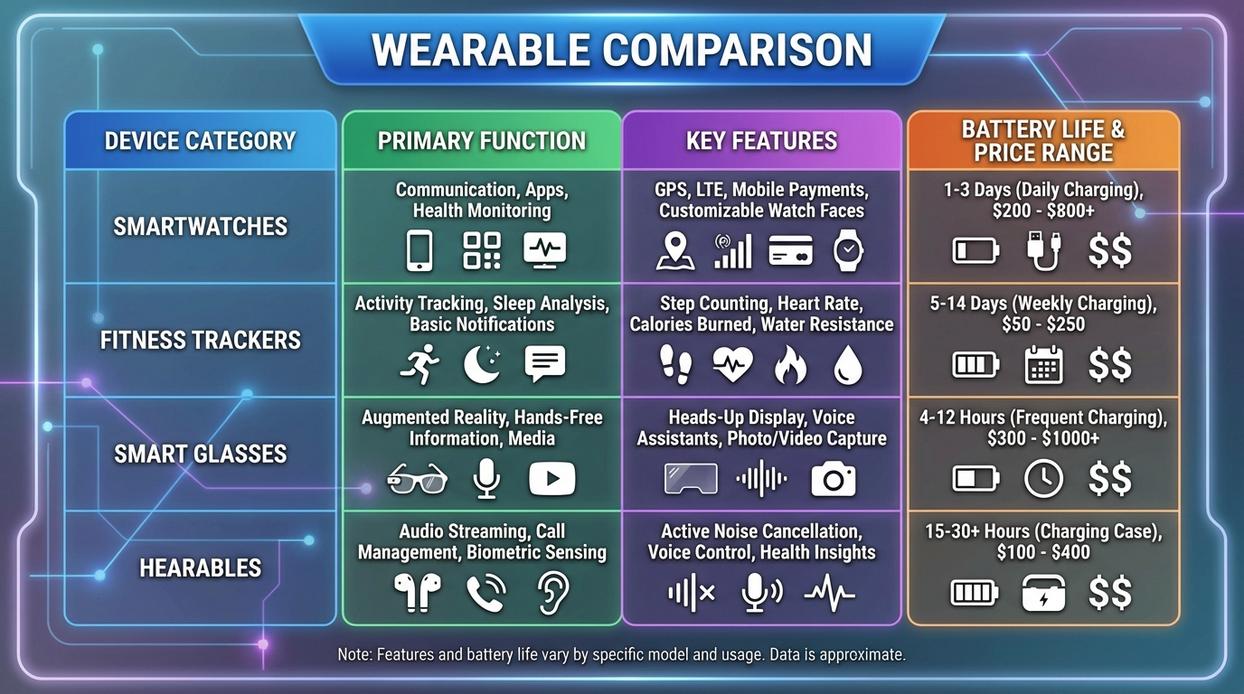
Smartwatches like Apple Watch and Samsung Galaxy Watch are the all-in-one devices most people picture. Think of them as a smartphone extension strapped to your wrist: notifications, third-party apps, ECG sensors, even contactless payments. I love the flexibility, but I’ll admit they can feel like information overload (buzz, buzz). Critics argue they’re overkill if you just want step counts, and they’re not wrong.
Fitness trackers such as Fitbit Charge or Garmin Vivosmart take a tighter focus. They prioritize heart rate, workouts, and long battery life over flashy apps. In my opinion, that simplicity is their superpower. You charge less, scroll less, and actually move more. Some say they lack innovation, yet focus often beats feature bloat.
Smart rings like Oura are the minimalist data collectors. No screen, no constant pings—just passive sleep and recovery insights. Discreet design, serious analytics. Detractors question the price, but if you value calm over clutter, it’s compelling.
This wearable technology comparison ultimately comes down to personality. Do you want a digital command center, a focused coach, or a silent analyst? For broader context, explore the rise of iot solutions in modern businesses.
Choose wisely.
Head-to-Head: Health and Fitness Tracking Accuracy
Heart Rate & ECG
Premium smartwatches like the Apple Watch and Samsung Galaxy Watch offer medical-grade ECG (electrocardiogram) features—tools that measure the heart’s electrical activity to detect irregular rhythms such as atrial fibrillation (AFib). The FDA has cleared ECG functionality on several models (FDA, 2022), which adds clinical credibility. That said, fitness trackers and rings often provide continuous heart rate monitoring, capturing trends 24/7 rather than spot checks.
Some critics argue ECG is overkill for healthy users (and can spark unnecessary anxiety). Fair point. But if you have risk factors—or simply want peace of mind—the on-demand ECG can be invaluable. Recommendation: If heart health is a priority, choose a premium smartwatch with ECG. If you just want steady trend data, a high-quality tracker or ring is sufficient.
Sleep Tracking & Recovery
Devices like Oura Ring and Fitbit deliver advanced sleep stage analysis (REM, deep, light sleep) using heart rate variability (HRV) and motion data. A recovery score is a composite metric combining HRV, resting heart rate, sleep quality, and activity strain to estimate how ready your body is for exertion. Entry-level smartwatches often track total sleep time only.
If optimizing recovery matters more than notifications, pick a device built for sleep first.
GPS and Activity Tracking
Garmin and Apple Watches feature built-in GPS for accurate distance and pace tracking—crucial for runners and cyclists. Simpler trackers rely on “connected GPS,” borrowing your phone’s signal (less convenient, sometimes less precise). Garmin stands out with dozens of sport profiles (triathlon, trail running, open-water swim).
In any wearable technology comparison, match the device to your goal: serious training equals built-in GPS and sport depth; casual fitness equals connected simplicity.
Beyond Fitness: Smart Features, Battery Life, and Design
Connectivity and Apps
If you want your wrist to replace your phone (at least occasionally), ecosystem matters. Apple’s watchOS and Google’s Wear OS offer deep third-party app libraries—think Spotify downloads, Google Maps navigation, Slack replies. Fitbit and Garmin rely more on proprietary systems, which are streamlined but limited. In any wearable technology comparison, this difference shows up fast.
Practical tip: before buying, list three apps you’d realistically use weekly. If they’re not supported natively, you’ll feel the gap within days (yes, even if reviews say you won’t).
LTE connectivity lets you leave your phone behind for runs, quick errands, or school pickups. It’s genuinely useful—provided you’re okay with extra carrier fees and slightly faster battery drain.
Battery Life Realities
Here’s what marketing pages don’t emphasize:
| Device Type | Typical Battery Life |
|---|---|
| Smartwatches | 1–2 days |
| Fitness Trackers | 5–10 days |
| Smart Rings | 4–7 days |
Always-on displays, continuous heart-rate tracking, and GPS workouts can cut battery life by 30–50% (Battery University). Real-world example: a 60-minute GPS run daily can turn a “2-day” watch into a nightly charger.
Pro tip: disable always-on display first—it’s the easiest win.
Design and Durability
High-end smartwatches use titanium and sapphire glass for scratch resistance and polish. Fitness trackers prioritize lightweight comfort (you’ll forget they’re there during sleep).
Check water resistance carefully. 5ATM supports swimming; IP ratings often mean shower-safe only. Don’t assume water resistance equals dive readiness. Even James Bond checks his gear twice.
The real deciding factor isn’t specs; it’s ecosystem and price. Platform lock-in—meaning your devices work best within the same brand family—matters more than flashy features. Apple Watch pairs seamlessly with iPhone, while Galaxy Watch fits Samsung and broader Android users. Want neutrality? Garmin and Fitbit play Switzerland in this wearable technology comparison. Think Avengers: everyone stronger on their home turf. THEN there’s cost. Entry-level trackers come in under $100, mid-range smartwatches sit between $250-$400, and premium models soar past $500. Don’t forget subscriptions like Fitbit Premium or Oura (those add up fast). Choose wisely. Budget BEFORE you tap buy impulsively.
Making Your Final Decision
You’ve explored how each device stands apart in function, form, and focus. This wearable technology comparison wasn’t about picking a universal winner—it was about helping you find what fits your lifestyle. The real frustration comes from choosing a device that doesn’t fully support your primary goal, whether that’s elite training metrics, deeper health insights, or seamless connectivity.
Now you know the difference. Premium smartwatches replace your phone. Fitness trackers deliver long battery life and performance data. Smart rings excel at discreet, sleep-focused tracking.
Still unsure? Don’t waste money on the wrong device. Explore our expert-backed guides and buyer breakdowns to confidently choose the wearable that actually solves your needs—start now.
 Founder & Chief Innovation Officer
There is a specific skill involved in explaining something clearly — one that is completely separate from actually knowing the subject. Ythran Draymond has both. They has spent years working with innovation alerts in a hands-on capacity, and an equal amount of time figuring out how to translate that experience into writing that people with different backgrounds can actually absorb and use.
Ythran tends to approach complex subjects — Innovation Alerts, Smart Devices and Solutions, Tech Landscapes and Trends being good examples — by starting with what the reader already knows, then building outward from there rather than dropping them in the deep end. It sounds like a small thing. In practice it makes a significant difference in whether someone finishes the article or abandons it halfway through. They is also good at knowing when to stop — a surprisingly underrated skill. Some writers bury useful information under so many caveats and qualifications that the point disappears. Ythran knows where the point is and gets there without too many detours.
The practical effect of all this is that people who read Ythran's work tend to come away actually capable of doing something with it. Not just vaguely informed — actually capable. For a writer working in innovation alerts, that is probably the best possible outcome, and it's the standard Ythran holds they's own work to.
Founder & Chief Innovation Officer
There is a specific skill involved in explaining something clearly — one that is completely separate from actually knowing the subject. Ythran Draymond has both. They has spent years working with innovation alerts in a hands-on capacity, and an equal amount of time figuring out how to translate that experience into writing that people with different backgrounds can actually absorb and use.
Ythran tends to approach complex subjects — Innovation Alerts, Smart Devices and Solutions, Tech Landscapes and Trends being good examples — by starting with what the reader already knows, then building outward from there rather than dropping them in the deep end. It sounds like a small thing. In practice it makes a significant difference in whether someone finishes the article or abandons it halfway through. They is also good at knowing when to stop — a surprisingly underrated skill. Some writers bury useful information under so many caveats and qualifications that the point disappears. Ythran knows where the point is and gets there without too many detours.
The practical effect of all this is that people who read Ythran's work tend to come away actually capable of doing something with it. Not just vaguely informed — actually capable. For a writer working in innovation alerts, that is probably the best possible outcome, and it's the standard Ythran holds they's own work to.